News & Notices

NIH to Begin Enforcing its Open Access Policy

With the publication of NOT-OD-12-160, the National Institutes of Health notified grant recipients that they will begin enforcing their public access policy in Spring, 2013 coincident with the final implementation of the use of the Research Performance Progress Report (RPRR) for SNAP and Fellowship awards. The NIH open access policy, announced in 2008, does not limit the journals in which award recipients publish their results, but does require that awardees to submit final peer-reviewed manuscripts that arise from NIH funds to the digital archive PubMedCentral upon acceptance for publication, to be made publicly available no later than 12 months after the official publication date.

Effective Spring 2013, NIH will delay processing of non-competing continuation awards if publications arising from that award are not in compliance with the NIH public access policy. This past Summer, NIH enhanced My NCBI, which is the tool through which researchers process their publications to be in compliance with the open access policy, adding features and streamlining functionality to make it easier to use.

Researchers submitting progress reports using the RPPR will find that its publication section is automatically populated with the PD/PIs publications from My NCBI and s/he needs only to check off the publications that are associated with that particular progress report. Grantees submitting paper 2590 progress reports will need to provide a My NCBI-generated PDF list of publications as part of their progress report.

Open access is certainly a buzz word in science circles today. The goal of open access proponents generally is to ensure that access to scientific literature is broadly available at low or no cost. We hear it from funding agencies like the National Institutes of Health (NIH) as well as the United Kingdom’s Research Councils, IrelandAustralia, and the European Commission is moving to improve open access. Major non-governmental sponsors such as the Wellcome Trust, Howard Hughes Medical Institute, and the Max Planck Society have incorporated open access policies into their funding policies and these three organizations have joined together to form a new open access journal – eLife. eLife joins the ranks of PLOS, publisher of several open access journals, and others. The Directory of Open Access Journals is one resource for finding open access journals.

2012 marked the sixth year of Open Access Week. The Budapest Open Access Initiative celebrated its tenth anniversary this year. And, the Berlin 10 Open Access Conference was held in Stellenbosch, South Africa.

In March 2012, the Office of Science and Technology Policy (OSTP), reported for the Obama administration to congress on Interagency Public Access Coordination – A Report to Congress on the Coordination of Policies Related to the Dissemination and Long-Term Stewardship of the Results of Federally Funded Scientific Research. OSTP notes in its report that since the inception of the NIH open access policy in 2008, over 260,000 papers have been submitted and are publicly available via PubMed Central, which contains over 2.4 million articles overall. Compliance with NIH’s open access policy stands at approximately 75%. Linking compliance with its open access policy to non-competing continuation awards should increase the compliance rate significantly. The National Science foundation (NSF) has taken an alternative approval to ensuring that research outcomes are available to the public in a timely manner by implementing a Project Outcomes Report (POR) requirement. The POR is a report written by the principal investigator of NSF-funded research specifically for public consumption. These reports are made available through Research.gov.

The Department of Energy (DOE) provides access to technical reports resulting from research at national laboratories as well as grantees via portals such as the DOE Information Bridge, which hosts nearly 300,000 reports. DOE also provides access to meta-data on roughly 10,000 scholarly publications annually, about 15% of which are fully available via public access. DOE also manages Science.gov, which provides access to 50 databases and over 200 million pages of R&D information across 14 federal agencies  including NIH’s PubMed, AGRICOLA and other important resources.

Clearly the tide of open access to publicly funded research data is still rising. NIH is taking its next step to move toward full compliance with its open access policy and governments, foundations and publishers around the world working to support the broad goals of the open access movement.
Congratulations to Argonne National Lab on Receipt of four R&D 100 Awards

InfoEd Global is happy to congratulate Argonne National Laboratory  on receiving four 2012 R&D 100 Awards.  These awards which originated in 1962 are issued annually for the top technologically significant innovations introduced to the market that year and are unofficially known as the “Oscars of Innovation.”

The Award recipients represent examples of top emerging technologies, instruments, systems, computers, safety systems, chemicals, consumer products, and equipment, to name a few categories.  The highest number of awards in 2012 came from the Analytical Instrument category.

Argonne Lab’s awards this year include:

InfoEd and Argonne are currently working together to implement the InfoEd Global eRA Software Solution at the Lab.  InfoEd Global provides a comprehensive, fully integrated software solution specifically designed to reduce the cost, time, and inefficacy that confront today’s research offices.  InfoEd’s electronic research administration suite is flexible yet affordable.  InfoEd’s mission is to provide the world’s best and most comprehensive software systems and tools for research and its administration; meeting the needs of today while solving the challenges of tomorrow.

Congratulations once more to Argonne National Laboratory and all recipients of the R&D 100 Awards for 2012!

NIH Commercialization Assistance Program for SBIR and STTR Phase II Awardees

If the purpose of university technology transfer is to maximize the benefits of public and private investment in research, those offices cannot rely exclusively on traditional licensing efforts.  Some technologies lend themselves to a more entrepreneurial approach, where the total impact of a start-up may significantly exceed the monetary value of a license to an existing company, if such a license could even be executed.

Such entrepreneurial activity has increased over the past few years, however start-up companies face significant challenges.  The risk remains that the start-up company will cease operations, before the benefit of the technology is fully realized.  In order for the company to continue after the original founders have moved on, or for the operations to attract the interest of a buyer before initial funding has run out, the market needs to be developed further.

One of the programs of the NIH seeks to address this by providing individualized assistance to SBIR and STTR Phase II awardees, focused on specific commercialization objectives.

Similar to the NSF I-CORPS program, the primary mechanisms of the Commercialization Assistance Program (CAP) are mentoring and advice.

  • One-on-one business  mentoring with a principal advisor focusing on concrete deliverables.
  • Advice from industry  experts on regulatory and licensing issues, business strategy, investor pitch.

Unlike the NSF I-CORPS program, there is no financial component to CAP however however, participants with a current active SBIR or STTR Phase II award may rebudget funds within the award, to cover allowable travel expenses for CAP events.  Certain restrictions apply.

There are 75 positions available for participation in teh next round, separated into two tracks:

  • Commercialization Training Track (CTT)With sixty (60) slots available, this track will apply to the majority of NIH SBIR/STTR Phase II companies. It is aimed at assisting participants with evaluating their commercialization options based on their specific technologies covering an 18-month period. It also assists participants in the development of market-appropriate tools to accomplish these objectives. Participants work one-on-one with a principal advisor and industry experts as needed.
  • Accelerated Commercialization Track (ACT)With fifteen (15) slots, this track will apply to a select group of NIH-funded companies who have successfully commercialized products and/or services, generated revenue, established partnerships and/or otherwise achieved a level of market development that is sustainable over a definitive period. However, they may need to address a specific applicable issue whose resolution is key to their continued growth. This track specifically deploys industry experts to help participants achieve these outcomes.

The current application period opened on October 17 and will close on November 7.

For more information, including eligibility criteria, the scope of the program, and a link to the application process, please refer to Program NIH-CAP 2012-2013.

University of Houston selects InfoEd Global Enterprise Software

ALBANY, New York — InfoEd Gobal, the leading provider of electronic Research Administration (eRA) software solutions, is pleased to announce the University of Houston has joined the InfoEd family. The University plans to re-engineer their processes by implementing the InfoEd Enterprise Solutions System including Grants and Contracts, IRB, IACUC, Conflict of Interest, and Technology Transfer modules.  Houston has also chosen to have InfoEd host their system as part of their effort to streamline the workflow of the Research Systems office.

Edward Johnson Jr., President of InfoEd commented: “We are excited to add University of Houston to the InfoEd family. The Research Administration team’s vision fits precisely with our goal of CPI, continuous process improvement, streamlining the University’s office and going toward paperless using InfoEd.”

What are the Kefauver-Harris amendments?

October 2012 marks 50 years since the passage of the Kefauver-Harris Drug Act of 1962, known less formally as the Kefauver-Harris drug amendments. The bill, named for US Senator Estes Kefauver of Tennessee and US Representative Oren Harris of Arkansas, amended the Federal Food, Drug and Cosmetic Act of 1938 to require:

  • Substantial evidence from clinical trials of both safety and efficacy – the FD&C Act of 1938 only required safety data
  • FDA approval prior to marketing – previously, approval was automatic if FDA did not act on an application within 60 days
  • Adherence to current good manufacturing practices (cGMP)
  • Closer monitoring of clinical trials and informed consent of participants
  • Disclosure of side effects in advertising
  • Monitoring and reporting of post-marketing safety information

Oversight of prescription drug advertising was transferred from FTC to FDA. The bill also outlawed the then-common practice of repackaging generic drugs under new trade names, which generated huge revenues for pharmaceutical companies at the expense of the public. All drugs approved prior to 1962 were to be re-reviewed to determine whether they met the new efficacy standard (ultimately, about one third of the drugs approved between 1938 and 1962 did not). That process led to the establishment of the Abbreviated New Drug Application (ANDA) approval pathway for generic drugs.

Senator Kefauver had been working since 1959 to rein in the pharmaceutical industry, investigating economic issues such as patent protections, drug costs and advertising practices. Just as the 1938 FD&C Act was inspired by the <a title="Elixir sulfanilamide – Wikipedia" href="http://en.wikipedia viagra kosten in der apotheke.org/wiki/Elixir_sulfanilamide” >elixir sulfanilamide tragedy, passage of the 1962 amendments was helped considerably by the thalidomide tragedy. Another important figure in shaping the legislation was pharmacologist and physician Dr. Frances Oldham Kelsey, the FDA reviewer credited with blocking the approval of thalidomide in the US.

Critics viewed the 1962 legislation as an excessive expansion of government power, since it greatly increased FDA’s control over pharmaceutical manufacturing and research. Following the revelation in 1961 that thalidomide caused severe birth defects, however, the American public – and Congress – were ready to support a stronger FDA.

US Congressional Records Become More Accessible for Research Administrators

Research Administrators Can Easily Access Congressional Bills and Other Information

The Library of Congress launched the Congress.gov website on September 19, 2012. Congress.gov is designed to provide free public access to legislative information. Technically, the Congress.gov website is in beta release currently, and contains House and Senate bills from 2001 to the present, profiles of all members of congress from 1973 to the present and selected member profiles from 1947 to through 1972. As Congress.gov matures, it will eventually replace Thomas.gov, created in 1995 to make federal legislative information available to the public.

Congress.gov website
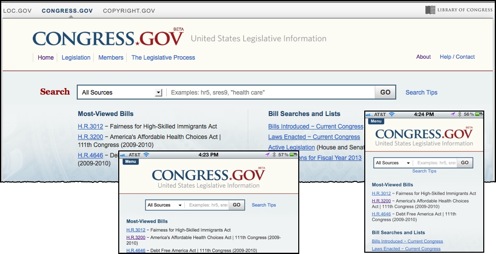
Congress.gov search screen displayed on various devices. Research administrators will appreciate the site technology and updated search feature.

Congress.gov is built using modern web technology that, among other advantages, fully supports accessing the site from desktop or laptop computers, tablets or smartphones with the results being displayed in device-friendly formats.

Research administrators often need information on pending or passed legislation to fully carry our duties. Presently, for example, the DATA Act is a hot topic and Congress.gov makes finding and reading that legislation easy by simply searching on that term “DATA Act” and then perusing the results or narrowing the list down until only the Senate and House bills are displayed.

The Thomas website was launched rapidly in response to the 104th Congress request to provide public access. Due to the limitations of Thomas, alternatives such as GovTrack.us have appeared to improve access to congressional information, track bills, hearings, committee meetings, and provide access to voting and other information on representatives and senators.

As pointed out by the Sunlight Foundation in its recognition of the Congress.gov website going live, there remains at least one significant gap between oft requested features and those provided by the new site: bulk access to the underlying data in a computer-readable format. This need has been noted for many years and was articulated recently in a report co-authored by staff at the Sunlight Foundation, GovTrack.us and Cornell University’s Legal Information Institute. This report was developed in response to a statement made by House leadership that endorsed bulk public access.

While blogs such as this one strive to alert research administrators to developing issues that merit their attention and provide basic information, ask questions and offer opinions, they are not always sufficient substitutes for reviewing the actual legislation, and that’s where Congress.gov will come in handy for all of us.

8.2% Reduction in US Science Budgets if Sequestraton is Implemented

No one ever expected that the across-the-board, draconian funding cuts identified as “sequestration” to be implemented. However, that’s just what will happen on January 2, 2013 unless the essentially dysfunctional US political system manages to get its collective act in gear to stop it.

Sequestration was proposed as a solution that was so drastic that it would force our leaders to come up with an effective solution to reduce the budget with less unwelcome impact while reducing the US budget deficit by $1.2 trillion. The White House released its required report to Congress on the potential impact should an alternative not be developed and sequestration be implemented. From the White House report, “no amount of planning can mitigate the effect of these cuts. Sequestration is a blunt and indiscriminate instrument.”

Some 1,200 budgets would be affected touching many important defense and non-defense programs. As summarized by Sarah Kliff on the Washington Post WonkBlog:

The sequester cuts in one graph

A quick reminder of what each of these categories encompasses:
    •    Non-exempt defense discretionary funding sees a 9.4 percent spending reduction. This covers things, such as keeping military bases open, paying salaries and research and development.
    •    Non-exempt mandatory defense spending sees the biggest cut of 10 percent.
    •    Non-exempt, non-defense discretionary funding gets cut by 8.2 percent. This includes anything that Congress has to authorize each year, so programs like Head Start and AIDS assistance.
    •    Non-exempt, non-defense mandatory programs see a 7.6 percent reduction. There’s not, however, much left to cut in this category because the large mandatory programs were largely shielded from the cuts. More on that right below.
    •    Medicare is, well, Medicare – the health insurance program for America’s seniors. The sequester specifically limited Medicare cuts to 2 percent of the program’s budget.
Keep in mind, certain programs are exempt from the sequester completely. Medicaid, the Children’s Health Insurance Program and Social Security, for example, do not get touched at all. And within the programs listed above, there are specific, smaller programs that get carved out as untouchable too.
Federal research programs at NIH, NSF, NASA, Dept. of Energy, NOAA, EPA, and others fall under the non-defense discretionary funding group and would be cut by 8.2%. David Malakoff provides a summary of the impact on science funding programs from the report at Science Insider.
There remains time for this situation to be resolved, but it will certainly not happen until after the November elections and then, a lame duck Congress will have to tackle the issue. Prepare for a bumpy ride.

NIH Announces 81 High Risk-High Reward Awards

NIH Announced  81 awards – 10 Pioneer awards, 51 New Innovator awards, and 20 Transformative Research awards – with total funding of approximately $155 million in 2012. These High Risk-High Reward program awards are given to allow talented investigators to pursue visionary science that has the potential to transform their area of science and speed the translation of research into improved health.

Congratulations to all of the 2012 recipients (the full list is available here). I want to particular note that a number of these awards were made to scientists at institutions using InfoEd Global’s research administration management software including Proposal Development and Proposal Tracking including:

Brigham and Women’s Hospital, Boston, MA
Columbia University, New York City, NY
Dana Farber Cancer Institute, Boston, MA
Massachusetts General Hospital, Boston, MA
Mount Sinai School of Medicine, New York City, NY
Northwestern University, Evanston, IL
Rockefeller University, New York City, NY
Sanford-Burnham Medical Research Institute, La Jolla, CA
University of Alabama at Birmingham, Birmingham, AL
University of California, Los Angeles, Los Angeles, CA
University of Illinois, Urbana-Champaign, IL
University of Pennsylvania, Philadelphia, PA
Yale University, New Haven, CT

UK Pledges £10 million Toward Open Access

Following up on recommendations from the Finch Report, the UK government will spread£10 million among 30 institutions receiving funding through the Research Councils and UK higher education funding councils to assist those institutions in transitioning to the open access funding model. Funds will be used for policy development and cover the costs of article processing charges (APC).

The UK Research Councils announced that they will provide block grants to support payment of APCs and expect that institutions will establish their own sources of support for APCs moving forward.

First Golden Goose Awards Announced

The Golden Goose Awards are intended to recognize investigators who have pursued what might have appeared at the time to be research topics of questionable value but have yielded valuable results. The name for the awards – Golden Goose – is a direct response to the Golden Fleece Awards given by the late Senator William Proxmire, which he awarded to researchers with funding to pursue studies he considered to be a waste of taxpayer money.

The real purpose of these awards is to recognize the value of serendipity in research – that pursuing questions that may seem odd can yield significant results. The investigators responsible for the discovery of green fluorescent protein used heavily in molecular biology research, inventing the Laser, and development of a new kind of bone graft are the first Golden Goose Award recipients viagra ohne rezept in berlin.